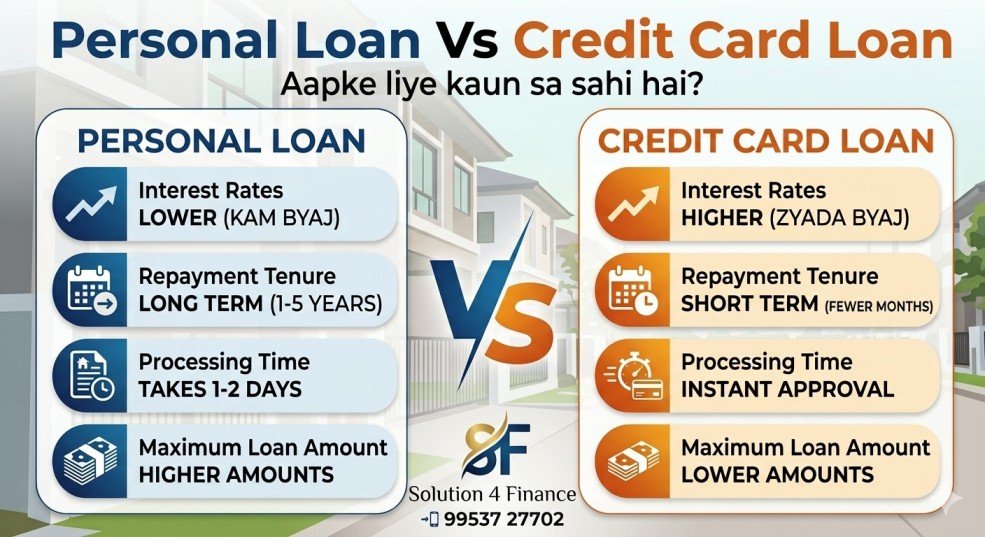
Personal Loan vs Credit Card Loan: Which Is Better in 2026?
When you need money for an important expense, a personal loan or credit card may be two options to consider. Both provide access to credit, but their repayment structure, cost and usage are different.
A personal loan generally gives you a fixed amount with a defined repayment period, while a credit card provides a revolving credit limit that you can use for eligible purchases.
Before choosing either option, it is important to understand the interest, fees, EMI structure, repayment period and effect on your credit history.
Personal Loan vs Credit Card: Quick Comparison
| Feature | Personal Loan | Credit Card |
|---|---|---|
| Credit type | Fixed-term loan | Revolving credit |
| Amount | Fixed approved amount | Based on available credit limit |
| Repayment | Usually fixed EMIs | Monthly statement payment |
| Tenure | Fixed | Revolving |
| Interest | Depends on lender and borrower profile | Can be high when balance is carried |
| Collateral | Usually unsecured | Generally unsecured |
| Main use | Planned or larger expenses | Purchases and short-term spending |
| Processing | Loan application and verification | Card application and credit assessment |
| Cost | Interest + applicable fees | Interest + applicable fees |
Actual rates, fees, limits and terms depend on the lender or card issuer.
What Is a Personal Loan?
A personal loan is usually an unsecured loan. This means you generally do not need to provide property or another asset as collateral.
Once approved, the lender provides a specific amount. You then repay the loan through monthly EMIs over an agreed tenure.
For example, if you borrow ₹2,00,000 for a particular period, your lender will calculate the EMI based on the applicable interest rate and repayment tenure.
Personal loans may be used for:
Medical expenses
Education
Home renovation
Wedding expenses
Emergency expenses
Travel
Major personal purchases
Debt consolidation
The lender may have its own rules regarding the permitted use of the loan.
How Personal Loan EMI Works
A personal loan normally has a structured repayment schedule.
Your EMI depends mainly on:
Loan amount
Interest rate
Loan tenure
A longer tenure can reduce the monthly EMI but may increase the total interest paid over the life of the loan. A shorter tenure can increase the monthly EMI but may reduce the overall interest cost.
Therefore, it is important to look at both monthly affordability and total repayment cost.
What Is Credit Card Borrowing?
A credit card provides a revolving line of credit up to an approved limit.
For example, if your credit limit is ₹1,00,000, you can make eligible purchases using the card within the available limit.
After each billing cycle, the card issuer generates a statement showing the transactions, total amount due and payment due date.
Credit cards can be useful for regular purchases, but they should be used carefully because carrying an outstanding balance can lead to interest and additional charges.
Understanding Credit Card Payments
A credit card statement can show different payment amounts, such as:
Total amount due
Minimum amount due
Payment due date
Paying only the minimum amount does not normally clear the entire outstanding balance. The remaining balance may continue to the next billing cycle and may attract applicable interest and charges.
For this reason, cardholders should understand their card's repayment terms instead of assuming that paying the minimum amount makes the borrowing cost-free.
Interest and Total Cost
The interest cost is one of the most important factors when comparing borrowing options.
For a personal loan, the total cost can depend on:
Interest rate
Loan amount
Tenure
Processing fee
Prepayment or foreclosure charges, where applicable
Other lender charges
For credit cards, the cost can depend on:
Outstanding balance
Applicable interest rate
Late payment charges
Cash withdrawal charges
Annual or joining fees
Other applicable charges
The advertised interest rate alone does not tell you the complete cost.
Before borrowing, check the total amount payable, applicable fees and repayment conditions.
Personal Loan EMI vs Credit Card EMI
A personal loan usually comes with a predetermined EMI schedule.
Credit cards normally work differently, but some card issuers may offer EMI conversion for eligible purchases.
For example, a cardholder may be able to convert an eligible purchase into monthly instalments. However, such conversion may involve interest and processing fees.
Before choosing a credit-card EMI facility, check:
EMI amount
Interest rate
Processing fee
Number of instalments
Total amount payable
Cancellation or prepayment conditions
Do not compare products only on the basis of the monthly EMI. A lower EMI can sometimes result from a longer repayment period.
Which Option May Suit a Larger Expense?
A personal loan can provide a fixed amount and a defined repayment schedule, which can be useful when you know exactly how much you need.
A credit card can also be used for eligible large purchases if enough credit is available. However, carrying a large unpaid balance for several billing cycles can increase the cost.
The important point is to compare the actual borrowing terms available to you before deciding.
Which Option May Suit Short-Term Spending?
Credit cards can be convenient for everyday purchases, online transactions and short-term spending.
Depending on the card, users may also receive:
Cashback
Reward points
Discounts
Promotional offers
Other card benefits
However, these benefits should not encourage unnecessary spending.
If you cannot comfortably repay the amount according to the card terms, interest and charges can reduce or completely outweigh the value of rewards.
Personal Loan and Credit Card Eligibility
Lenders and card issuers generally consider several factors when evaluating an applicant.
Personal loan eligibility may depend on:
Age
Income
Employment or business stability
Credit history
Existing EMIs
Existing debt
Repayment capacity
Lender-specific policies
Credit card issuers may consider similar information, including income, credit history and existing financial obligations.
Meeting the basic eligibility criteria does not guarantee approval because every lender or issuer may use its own assessment process.
Documents You May Need
For a personal loan, the lender may ask for:
PAN Card
Aadhaar Card or another accepted KYC document
Address proof
Salary slips
Bank statements
Form 16 or income documents
Business or income documents for self-employed applicants
For a credit card, the issuer may request:
PAN Card
Identity proof
Address proof
Income proof
Bank statements
Other KYC documents
The exact documents depend on the financial institution and applicant profile.
Credit Score: Why It Matters
Your borrowing behaviour can become part of your credit history.
Important factors can include:
Repayment history
Outstanding debt
Credit utilisation
Number of credit accounts
Recent credit applications
Length of credit history
For credit cards, credit utilisation is particularly important because consistently using a very large portion of your available limit can be viewed as a sign of higher credit dependence.
For both personal loans and credit cards, making payments on time is important.
Avoid taking multiple loans or credit facilities simply because they are available. Consider whether the combined repayment obligations are affordable.
Fees and Charges to Check
Never look only at the interest rate.
For a personal loan, check:
Processing fee
GST or applicable taxes on charges
Late payment charges
Prepayment charges, where applicable
Foreclosure conditions
Other service charges
For a credit card, check:
Joining fee
Annual fee
Interest charges
Late payment charges
Cash withdrawal charges
Foreign transaction charges
EMI processing fees
Other applicable charges
The current fee schedule and terms should always be checked before accepting the product.
What Happens If You Miss Payments?
Missing a payment can have financial consequences.
Depending on the product and terms, you may face:
Late payment charges
Additional interest
Increased outstanding balance
Negative impact on credit history
Repeated missed payments can make future borrowing more difficult or expensive.
If you are having difficulty making a repayment, contacting the lender or card issuer early may be better than simply ignoring the payment.
Personal Loan vs Credit Card for Debt Management
Using one form of credit to pay another debt should be approached carefully.
For example, taking a personal loan to repay credit card debt may sometimes reduce the cost if the new loan has suitable terms. However, this is not automatically beneficial.
Before doing this, compare:
Existing credit card outstanding
New loan interest
Processing fees
Remaining repayment period
Total amount payable
Any prepayment charges on the existing debt
Most importantly, understand why the credit card balance increased in the first place. Replacing the debt without changing spending habits can lead to new debt after the transfer.
How to Choose the Right Credit Option
Before applying, ask yourself five important questions.
1. How much money do I actually need?
Borrowing more than necessary increases your repayment obligation.
2. How quickly can I repay it?
Choose a repayment structure that fits your monthly income and expenses.
3. What is the total cost?
Calculate interest and applicable fees instead of focusing only on the EMI.
4. Can I make every payment on time?
A repayment plan should leave enough room in your monthly budget for unexpected expenses.
5. Have I compared actual offers?
Interest rates, fees and eligibility can vary between financial institutions. Compare the actual terms offered to you.
Example: ₹1,00,000 Requirement
Suppose you need ₹1,00,000 for an important expense.
With a personal loan, you may receive the approved amount and repay it through scheduled EMIs over the agreed tenure.
With a credit card, you may use your available limit for an eligible transaction. If you pay the applicable statement balance according to the card terms, the cost can be different from carrying the balance forward.
If the credit card balance remains unpaid, applicable interest and charges may increase the total cost.
This example shows why you should compare total repayment cost and repayment flexibility, rather than simply asking which product has a lower monthly payment.
7 Things to Check Before Borrowing
Before taking a personal loan or using credit-card borrowing, check:
Interest rate
Total repayment amount
Processing and other applicable fees
Repayment period
Prepayment or foreclosure conditions
Late payment charges
Monthly affordability
Also read the important terms and conditions before accepting the credit facility.
Common Mistakes to Avoid
Paying Only the Minimum Credit Card Amount
The minimum payment can keep the account from becoming overdue according to the card terms, but it does not necessarily clear the full balance. Interest can continue on the remaining amount.
Choosing a Loan Only Because the EMI Is Low
A lower EMI may result from a longer tenure. Always check the total repayment.
Ignoring Fees
Processing fees, annual fees and other charges can increase the actual cost of borrowing.
Borrowing More Than Required
A higher loan or credit limit does not mean you should use all of it.
Applying for Too Much Credit at Once
Multiple credit applications within a short period may affect your credit profile and can signal increased credit-seeking behaviour.
Frequently Asked Questions
Is a personal loan cheaper than a credit card?
Not necessarily in every situation. The actual cost depends on the interest rate, fees, repayment period and how the credit is used.
Can I use a credit card for a large purchase?
Yes, if the purchase is eligible and you have sufficient available credit. However, carrying a large outstanding balance can increase borrowing costs.
Is a personal loan better for planned expenses?
A personal loan can provide a fixed amount and structured EMI repayment, which may be useful for a planned expense. The actual suitability depends on the loan terms and your repayment capacity.
Does a personal loan affect credit history?
Yes. A personal loan and its repayment behaviour can form part of your credit history.
Can credit card usage affect my credit score?
Yes. Factors such as payment history, outstanding balance and credit utilisation can affect your credit profile.
Can I have both a personal loan and a credit card?
Yes, subject to the applicable eligibility and approval criteria. However, you should make sure that the combined repayment obligations remain affordable.
Should I convert a credit card purchase into EMI?
It depends on the interest rate, processing fee, tenure and total repayment amount. Check the complete EMI terms before converting a purchase.
Final Thoughts
A personal loan and a credit card are different financial products designed for different types of borrowing.
A personal loan generally provides a fixed amount and structured EMI repayment, while a credit card provides revolving access to credit.
The right decision should be based on your actual requirement, repayment capacity, interest cost, fees and the terms offered by the lender or card issuer.
Before borrowing, calculate the total cost, understand the repayment schedule and avoid taking more credit than you can comfortably manage.
Responsible borrowing starts with understanding the complete cost before you borrow.